Pages

Saturday, October 21, 2006

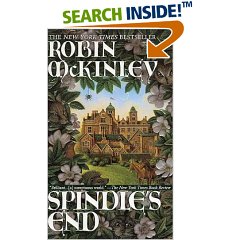
Spindle's End by Robin McKinley


I recently read McKinley's Beauty and thoroughly enjoyed it. Spindle's End is a retelling of the story of Sleeping Beauty. Again, I typically don't like Stories Re-Told but McKinley seems to have a way about her that I quite enjoy. Growing up little girls are told of the lovely fair maidens who are rescued by the handsome prince. Please do not misinterpret- I think those stories are charming and well-told. They are perfect in their place. McKinley just challenges the place.

I was trying to figure out what it is about McKinley that I find so appealing. Perhaps it is that while most girls dream of growing up to be that rescued princess, we all, in part, doubt that we will be. McKinley's heriones are more "true to life" shall we say? I would also speculate that she leans towards modern day feminism which is attractive to females although not all together a good thing. McKindley's princesses are incredibly de-Disney-fied, no ringlets, chicks with attitudes females. Particularly her "Sleeping Beauty" (who sleeps for a period less than about 5 minutes, I'd say). There's more macho in the princess than silk and lace.

This comes as a refreshment on the one hand, and on the other, it does give one pause. There's something elegant and mystical that is missing in McKinley's work that a girl just HAS to miss. Knights on white horses are dreams ingrained within the female race -- even though some women seem to howl in protest at the mere thought. We were created wanting to be rescued -- as well as wanting to take over. McKindley allows her princess to take over. It's an improper balance.

Still, there is humor in Spindle's End and magical delight. It's not "La Belle au Bois dormant" but there is a handsome prince, lots of fairies, enchantment and the inevitable ball. The villian isn't quite as scary as the Disney cartoon makes her out to be, but that's perhaps because she's in black & white ink and the imagination can stave off the horns on the cartoon version's head for more palatable reading. (I was always terrified of that cartoon witch.)

I debated over whether or not McKinley is really doing us any favors with these modern day retellings. The romance and magic fades when the Princess (who chooses to go by the name "Rosie") runs around with hair cropped, in men's clothing and insists on being dirty. It doesn't really fit the mind's mold of "princess." Pushing out the male characters to lesser roles of lesser nobility and honor does tend to hurt the story in the long run. However, her characteres, for the modern day American woman, are more personable and enjoyable. It's much easier to believe one can be like Rosie as not. And perhaps that's where McKinley is useful. In today's day and age where women struggle with so many insecurities, its fun to get lost in a book that leaves you feeling like anything is possible and you too really CAN be a princess. It beats wishing for a pointy hat with silk dangling off the end of it. Although there is a time and place for silk as well. On the whole, I'd have to recommend Spindle's End and McKlinley's work in general. For the original idea.

Tuesday, October 17, 2006

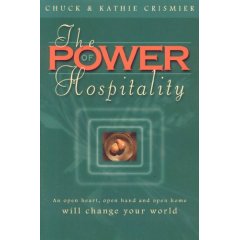
The Power of Hospitality, by Chuck Crismier


I had to read this book in a day because it was a 14 day check out from the library and I didn't realize I couldn't renew it until the 14th day of "ownership." Therefore I rather flew, skipped and skimmed my way through it to get the general idea of what Crismier was trying to communicate.

Being one who is rather given to hospitality and who enjoys having people over and throwing parties, I picked up this book on a whim. I didn't pick it up so much for the encouragement to "try" so much as to beef up my feelings of Why This Should Be So For Everyone. I find the topic curious.

Crismier does a pretty good job of Biblically suggesting why we are to be "given to" hospitality (and not necessarily "gifted in" before we give it a try)! I do think he stretches some of his Biblical examples but I agree that the basic scriptural directive to have open hearts towards each other remains. His basic premise seems to be that we are blessed so that we can bless others. Hospitality is kingdom work. It is not meant for only certain classes or people of certain status. It is meant for all. It should not matter whether your house is large or small, whether you are black or white, single or married, rich or poor. Everyone has been given something to share and he suggests that the best way to build a kingdom community is to share what we have. Open hearts and open homes.

The thing I did not like about his book, and truthfully found completey distracting, was that it felt like he wrote it in pieces and then in the end he threw all his chapters together in some random order. It felt like he didn't realize that in so doing, he had repeated himself in other chapters and then just forgot. He gave the same statistics, same quotes and, on occassion, told the same stories several times. It made me wonder if an editor was involved at all. Despite this, it is a good reminder that we are to care more for the needs of others than for ourselves.

Personally, if I were to recommend a book on hospitality, I would recommend the book Face to Face: Meditations on Friendship and Hospitality by Steve Wilkins (published by Cannon Press). I think Face to Face has better flow, is more scripturally on point, and skips giving the napkin folding/table decorating suggestions at the back of the book. I think such suggestions are better found in Martha Stewart magazines than in a scriptural thesis on the subject. Nevertheless, when there are so few books on a topic, The Power of Hospitality is not a bad one to pick up. Just perhaps not the best.

Monday, October 16, 2006

The Rescuers, by Margery Sharp


I stumbled across this book at the library when I went to pick up another title. The Rescuers waved at me from the shelf. I rather enjoyed the Disney cartoon classic (1977) by the same title when I was growing up. The characters of Miss Bianca and Bernard saving young Penny and her stuffed teddy bear from Madame Mudusa and her hungry pet alligators were just fun. The idea of two mice being sent out to rescue a young and very cute orphaned girl is imaginative. I didn't realize that the Disney version was based on a series of books.

The Rescuers is a quick read and is entirely unlike the cartoon classic, although still just as fun. The character's were most definitely based on Sharp's vision for them. Miss Bianca is a "high society" rodant and Bernard lives in the pantry. However, their roles were something of a reverse between the book and the movie. The book portrays Miss Bianca as living the high life with no knowledge of life in the "real world." The smell of tobacco makes her sick and in the book she has to overcome the habit of fainting at the slightest provocation. Bernard, on the other hand, is more on the ball and "to the rescue" sort. In the movie, these roles are rather reversed.

The other difference between the book and movie is that the mice in the book belong to the Prisoners Aid Society and their mission is to comfort prisoners and, in some cases, to help them escape from jail. This is the mission for Miss Bianca, Bernard and another mouse by the name of Nils in the book. Still I can't help but sing the tune in my head as I read, "R-E-S-C-U-E . . . Rescue Aid Society! Heads held high! Touch the sky!..." (Gotta love Disney songs.)

The Rescuers is a very cute book. An old library card taped in the back of this library copy has it stamped as acceptable reading for "Grades 5 and up." However, I think it would be an excellent read-aloud book for kids much younger than that! It's a story in keeping with The Wind in the Willows and Charlotte's Web. Very fun. Here's a list of the other books in Sharp's Rescuers series:

The Rescuers (1959)
Miss Bianca (1962)
The Turret (19??)
Miss Bianca in the Salt Mines (19??)
Miss Bianca in the Orient (19??)
Miss Bianca in the Antarctic (19??)
Bernard into Battle (19??)
Bernard the Brave (19??)
Miss Bianca and the Bridesmaid (19??)

I may have to pick up some of these books from time to time and slowly read through the series.

Saturday, October 14, 2006

Future Men, by Douglas Wilson


If you haven't guessed by now, we particularly enjoy Wilson's books on child rearing. We feel confident that he has a level-headed and biblical approach to the challenge. While some may disagree with us on this point, we will disagree with them.

Many of Wilson's books overlap in wisdom, instruction and definitely in tone. However, this doesn't prompt us to avoid any particular title. As he mentions in the introduction to Future Men, each topic deserves its own points. While it is true that his book Standing on the Promises contains some of the same information as Future Men, FM is directed specifically at raising men. As it seems that such a task lies in our future, this seemed a worthy read.

Wilson tidily sums up his book with his basic truth and premise in which he states:

"Boy are future men. Young men are future men. This means they are future husbands and future warriors. When they arrive at that point, the responsibilities they encounter must not come as a surprise to them." (page 171)


The idea behind this book is that a baby boy is a future man and should be treated and reared as such. Does this mean that he is automatically given the responsibilities of a man and that all expectations of his future are laid at his door step the moment he takes his first breath? No. But it does mean that we are to acknowledge a difference between the male and female sexes and that they are to be raised differently. A boy will have energy and strength, which is rightfully born with, which needs tempering and guidance. It is not wrong for a boy to want to be "tough" and rowdy -- but how such behavior is displayed does need direction from his parents. Not everything is acceptable.

For example, Wilson mentions that there are many Christian (and otherwise!) parents who do not think it proper for a young boy to want to play with guns/swords and/or rough house. Wilson suggests that it is just as natural for a boy to want to play the warrior as it is for a little girl to want to mother a baby doll. Both sexes reactions are correct and biblical. However, many boys are discouraged from "playing" at war. I've known a few families who are against the idea of their sons playing with toy guns or swords. But we must come to recognize that this male trait is honorable and we must teach our sons to act honorable with such weapons and in such a way of behaving. Wilson says:

"This means that a boy who is playing with a toy gun should be trained to never use it more freely simply because it is not real. A small boy who is playing war with his brothers should be pointing and blasting away with the best of them. But if a lady from church comes over to visit the young boy's mother, and is standing in the foyer, and the boy comes up and tries to blow her away, the young warrior's mother should haul him off to the bedroom to be tried for war crimes. The visitor was a civilian and noncombatant, and Mother should be schooled in the principles of just war theory, and she should enforce the rules." (Page 131)


In short, a boy should not be condemned for his strength or sense of loyalty, honor and dignity. However, proper training is involved to ensure that he grows up knowing exactly what those words mean, biblically speaking.

I think for me, reaching this point of the book, I realized (again) how very important it is for a father to be involved in the raising up of his sons. As Wilson says - a father raises his son by remembering what it was like to be one. A mother raises a son without remembrance. I've never been a son. I don't know how to be one. Therefore I am 100% reliant on my husband to tell me what it was like to be one and why my son is behaving the way that he is. This by no means indicates that mothers aren't capable of raising sons. Obviously we are! But the father figure is vital.

Also, Wilson is a proponent (as are we) of introducing our future young man (men) to stories of heroes of the faith and other great literary characters who display traits that we wish to instill within our sons. For example, King Peter from The Chronicles of Narnia, Aragorn from Lord of the Rings, etc. These are literary characters of honor and deserve a place within our son's imagination. There is absolutely nothing wrong with the idea of teaching character traits through the use of a good story. Jesus happened to use the same method himself when trying to communicate biblical truths (i.e., the Parables). We can learn from Jesus' example when trying to impart truths to our children as well.

Obviously this book has a lot to say on the Art of Raising Men. I've merely scratched the surface. The bottom line is, we need to realize that little boys will one day be grown men. As Wilson says - what they are a little of right now, they will be a lot of later. It is important to guide and direct them into being the Men of God we pray they will be. This includes training in areas such as 1. Biblical instruction 2. general education 3. finances 4. respect for women and the list is longer.

This is a book we would recommend for any parent of a young boy, even if it just to prompt a little thought towards the idea of this world's future men. Who do we want them to be? What do we want them to look like? How do we wish for them to behave? Who do we wish for them to serve? These questions shouldn't be asked when they are 15 or 16 for then the training period is pretty much over. These questions should be asked from the cradle when the little man can get the most "bang for his buck" out of his parents. The time to start training is now so that when the time comes to let go - they are ready to stand on their own as Men in their own right.

Sunday, October 08, 2006

List of Montgomery's Works


You asked for and here it is:

NOVELS:

1908 - Anne of Green Gables
1909 - Anne of Avonlea
1910 - Kilmeny of the Orchard
1911 - The Story Girl
1913 - The Golden Road (sequel to The Story Girl)
1915 - Anne of the Island
1917 - Anne's House of Dreams
1919 - Rainbow Valley
1920 - Rilla of Ingleside
1923 - Emily of New Moon
1925 - Emily Climbs
1926 - The Blue Castle
1927 - Emily's Quest
1929 - Magic for Marigold
1931 - A Tangled Web
1933 - Pat of Silver Bush
1935 - Mistress Pat (sequel to Pat of Silver Bush)
1936 - Anne of Windy Poplars
1937 - Jane of Lantern Hill
1939 - Anne of Ingleside

SHORT STORY COLLECTIONS:

1912 - Chronicles of Avonlea
1920 - Further Chronicles of Avonlea
1974 - The Road to Yesterday
1979 - The Doctor's Sweetheart
1988 - Akin to Anne: Tales of Other Orphans
1989 - Along the Shore: Tales by the Sea
1990 - Among the Shadows: Tales from the Darker Side
1991 - After Many Days: Tales of Time Passed
1993 - Against the Odds: Tales of Achievement
1994 - At the Altar: Matrimonial Tales
1995 - Across the Miles: Tales of Correspondence
1995 - Christmas with Anne and Other Holiday Stories

POETRY:

1916 - The Watchman & Other Poems
1987 - The Poetry of Lucy Maud Montgomery

NON-FICTION:

1934 - Courageous Women (with Marian Keith and Mabel Burns McKinley) *

*This is the only piece of Montgomery's that I haven't read, simply because I cannot locate it.

Friday, October 06, 2006

The Blue Castle, by Lucy Maud Montgomery


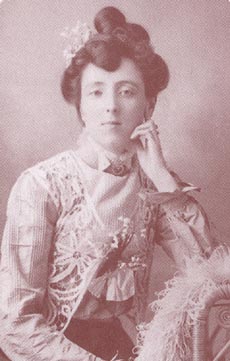
I just finished re-reading Montgomery's The Blue Castle. It's been a few years since I've picked up this book. Montgomery, as many of you are aware, is my favorite author. As far as I'm concerned, I will never find another series as captivating as her Anne of Green Gables. I continue to love the innocence and imagination of Anne. One of the most fabulous vacations I ever took was a trip to Prince Edward Island where I discovered that the Island that Montgomery wrote about was every bit as lovely as she had ever said. I own every L. M. Montgomery book that's been published. I keep hoping for the Undiscovered Manuscript.

The Blue Castle is Montgomery-ish to its core. The way she describes nature in this book is in keeping with all her other writings. She seemed to love being out doors. Growing up in an area of the country that was perpetually hot, I always wondered what it would be like to actually WANT to go and explore the outdoors. I envied Montgomery's characters their freedom in being able to go outside without sweating to death. It was a little dream of mine to end up living some place where the temperature was cool enough to provoke one to open the windows and let the breeze blow through.

Perhaps that's why I liked The Blue Castle as much as I did. The book's heroine is named Valancy Sterling. She grew up in a rather confining environment wherein she was not allowed to romp through forests and skate on frozen lakes. While my situation was due to geography, hers was due to a strict upbringing by a mother and various relatives who thought too much on illness as opposed to freedom and exploration. Valancy spends the first 29 years of her life wishing for adventure but being afraid to search for it. She is the assumed Old Maid of the family who is carefully guarded from disease and free thoughts. She lives in a rut and her life's excitement is wrapped up in nature novels that her aunt allowed her to read only because she thought they were more educational in nature. To Valancy the nature novels were poetry themselves and she longed to know what the author of the books was writing about.

Valancy's real story begins when, believing herself to be as ill as relatives tell her, consults a non-family doctor regarding a heart condition. The doctor diagnoses her as having a fatal heart disease and advises her to take things as easy as possible. This prompts Valancy to reject family opinion and counsel and embark on a few adventures to see what life can be like when one is free to explore. Ultimately, Valancy's explorations leads her to the alter with one Barney Snaith, a reputed jail bird, according to local town gossip.

For the first time in her life, Valancy knows what it's like to love - and be loved. She finds out what it's like to decorate one's own home in the manner which she chooses without having to submit all her decisions for some relative's final approval. She can trounce about in the woods, not wear a hat when it snows, cook food over an open fire, and wear her hair however she likes. She learns to love life.

The book is really a Coming Out, so to speak, of a person who finally decided that they weren't going to wait for life to come to them. She was going to take life by the horns and wrestle from it an adventure or two. She was brave enough to set aside the opinions of others to do what she knew she needed to do in order to live. This book is unlike Montgomery's "lighter" writings, like Anne or Emily. The book doesn't focus on the growing-up struggles of a young girl, but instead a 29 year old believed to be set in her ways but whom everyone discovers has a vibrancy inside of her that was just waiting to be unleashed.

The Blue Castle was just an enjoyable read for me the second time as it was years ago when I first picked it up. I'd highly recommend it. To be sure, its a "darker" work in some respects, but that's only because the characters are older and more mature. It's still Montgomery in essence. And that makes it enjoyable in and of itself.
Top  blogs